Can You Turn a Patio Cover Into a Sunroom?
It seems like an easy upgrade: you already have a roof, so why not add walls and windows? Sometimes that works, but often it does not, because of how patio covers are built and how cities regulate them. Here is what to know before you plan.
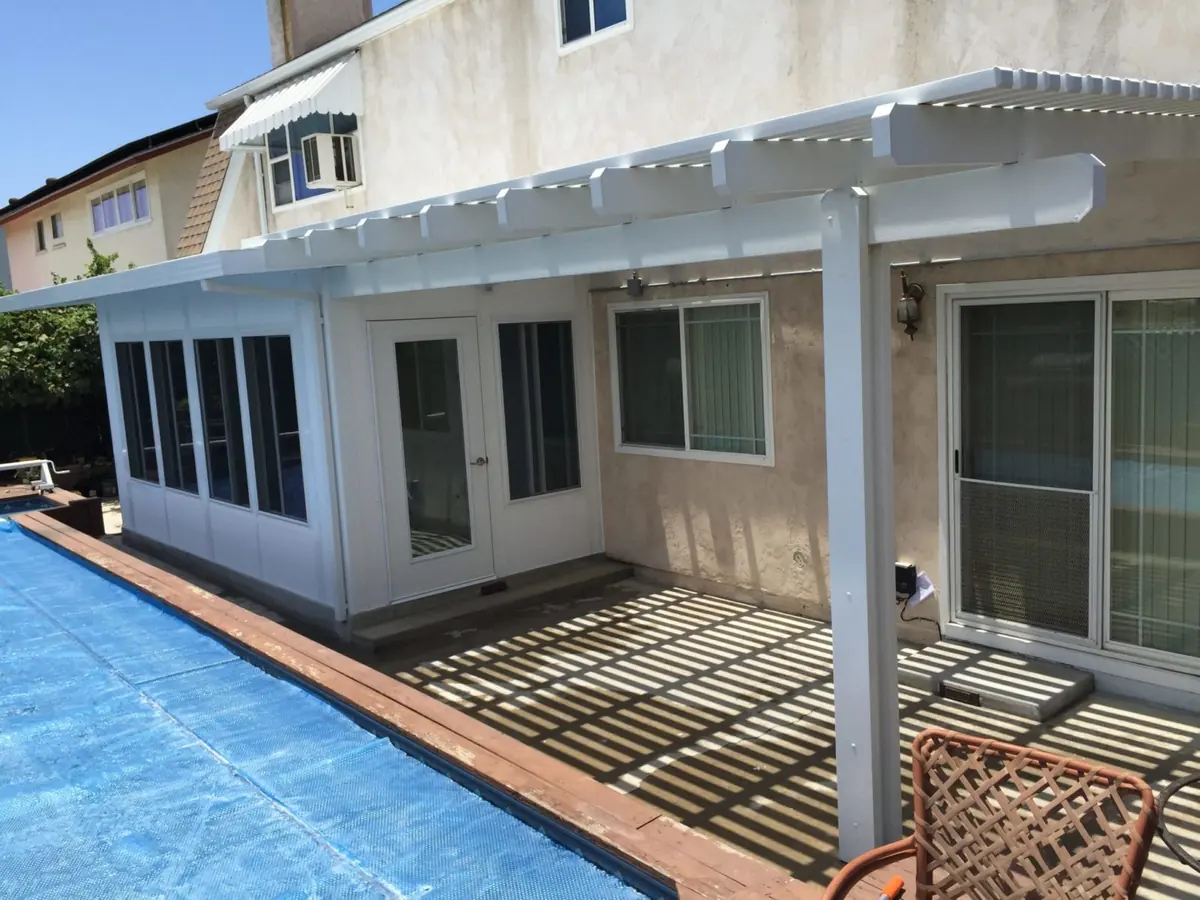
Why it is not as simple as adding walls
A patio cover is designed and permitted as an open structure. A sunroom is designed as a room. That difference shows up in three places:
- Structure: patio cover posts, beams and footings are sized for an open roof. Walls, windows and wind loads on an enclosed room can require larger footings and framing.
- Foundation: a sunroom usually needs a slab or footings that meet code for a room, and an existing patio slab may not qualify.
- Code and energy rules: a room that is heated or cooled and opens to the house is treated as an addition and must meet California's energy code.
What cities allow
Many San Diego County cities limit how much of a patio cover can be enclosed. A common rule is that the longer side and one more side must stay at least 65 percent open. Chula Vista does not allow a patio cover to be used as living space, and Escondido does not allow a standard patio cover to simply be walled in. When a fully enclosed room is the goal, it is usually permitted as a sunroom or room addition instead.
Here is what we know for each city we serve:
- San Diego: Often, yes, but an enclosed patio is treated differently from an open cover and usually needs a permit even when a small open cover would not. A contractor will confirm what the city requires.
- Chula Vista: Chula Vista does not allow a patio cover to be used as living space, so a fully enclosed, conditioned room is usually permitted as a sunroom or room addition instead. A contractor can tell you which route fits your plans.
- Oceanside: Often, yes. Screen and vinyl enclosures are popular in Oceanside for blocking the evening breeze. A contractor will check that your existing cover can support the panels and confirm what the city requires.
- Escondido: Escondido has a separate guideline for patio enclosures, and a standard patio cover cannot simply be walled in. A contractor will confirm which rules apply to your project.
- Carlsbad: Often, yes, but plan for extra review. Enclosures change how a structure is classified, and Coastal Zone homes may have added steps. A contractor familiar with Carlsbad can map out the approvals.
- El Cajon: Possibly, within limits. Under El Cajon's standard drawings, the longer side and one additional side of a patio cover must stay 65 percent open. A fully enclosed room is usually permitted as a sunroom or addition instead.
- Vista: Within limits. Vista requires at least 65 percent of the longer wall and one additional wall of a patio enclosure to stay open, and sliding glass doors do not count toward that open area. Fully enclosed rooms are permitted differently.
- San Marcos: Within limits. San Marcos requires the longer wall and one additional wall of a patio enclosure to stay at least 65 percent open, and egress rules apply if bedrooms open onto the patio. A contractor can tell you whether a sunroom is the better route.
- Santee: Often, yes. Screen enclosures are popular in Santee for bug-free summer evenings. A contractor will check that your cover can support the panels and confirm what the city requires.
- Encinitas: Possibly, but carefully. Encinitas requires patio covers to stay open on at least three sides, so a fully enclosed space is usually permitted as a sunroom or addition, which can mean coastal review. A local contractor can map out the options.
- La Mesa: Often, yes. Screen and vinyl enclosures are common on La Mesa patios. A contractor will check that your existing cover and footings can support the panels and confirm what the city requires.
- Poway: Within limits. Poway requires at least 65 percent of the longer wall and one additional wall of a patio enclosure to stay open, and covers must stay open where bedroom windows serve as emergency exits.
- National City: Often, yes. Screen and vinyl enclosures are popular in National City. A contractor will check that your existing cover can support the panels and confirm what the city requires.
- Rancho Bernardo: Often, yes, within City of San Diego rules. A contractor will check that your cover can support the panels and confirm what the city requires.
- Spring Valley: Often, yes. A contractor will check that your cover can support enclosure panels and confirm what the County requires for your project.
- Ramona: Often, yes. Enclosures and sunrooms are popular in Ramona for cool evenings and winters. A contractor will confirm what the County requires.
Your realistic options
Partial enclosure within the rules
If your city allows it, screens, clear vinyl or removable panels can block wind and bugs while keeping the required open area. This is the most affordable route and works well with an existing cover. See screen rooms and patio enclosures.
Reinforce and permit as a sunroom
Sometimes an existing roof can be reused if an engineer confirms it, and new footings, walls and windows are added under a sunroom permit. A contractor will check the roof, posts, footings and slab before quoting.
Replace with a new sunroom
Often the cleanest path is removing the cover and building a sunroom designed as a room from the start, with the right foundation, insulated roof and glass. It can cost more up front but avoids surprises.
Questions to ask a contractor
- Can my existing cover and slab support walls and windows, and will you confirm that with an engineer?
- What does my city allow for enclosing a patio cover?
- Would this be permitted as a sunroom or an addition?
- Do I want heating and cooling? That decides which energy rules apply.
Compare costs in our sunroom cost guide, including patio enclosures at about $8,700 to $28,400 nationally.
Ready for a Free Estimate?
Tell us about your project and one licensed, insured local contractor will contact you within 1 business day.
Get a Free EstimateCommon Questions
Can I enclose my patio cover without a permit?
Usually not. Enclosing a cover changes how it is classified, and many cities limit how much of a patio cover can be enclosed. A fully enclosed room is typically permitted as a sunroom or addition.
What is the 65 percent open rule?
Several San Diego County cities, including Vista, San Marcos, El Cajon and Poway, require the longer side and one additional side of a patio cover to stay at least 65 percent open unless the space is permitted as a room.
Is it cheaper to convert a patio cover than build a sunroom?
A partial enclosure with screens or vinyl is much cheaper. A full conversion can be, if the existing structure qualifies, but it often needs new footings, walls and roof work, so get a contractor to inspect it first.
Sources
HomeAdvisor: Patio Enclosure Cost Guide · City of San Diego: Information Bulletin 206, Patio Covers · City of Vista: Patio Cover Permit Requirements · City of Chula Vista: Patio Covers · City of Escondido: Patio Enclosures Guideline · City of El Cajon: Patio Cover Standard Drawings · City of Poway: Patio Cover Information Bulletin. Rules and prices change, so confirm details with your city and contractor.